



Evidence over adjectives
Every accuracy figure on this platform corresponds to a published, peer-reviewed result. If a claim cannot be traced to a paper, it does not appear here.

About OrthoAI
OrthoAI started as a research programme in computer vision and clinical AI. The platform exists to put that research into the hands of the people who carry the clinical and operational weight.
our vision
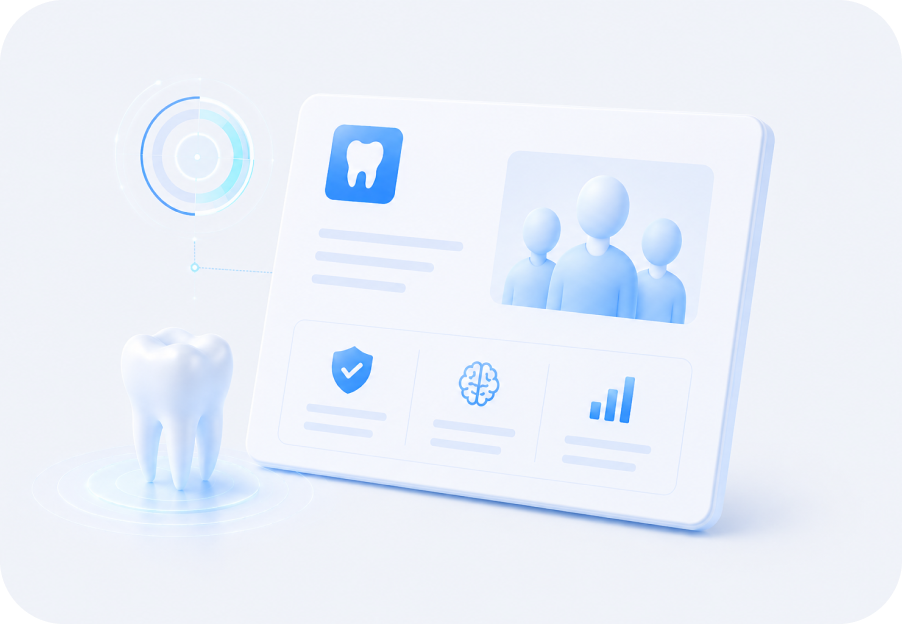
Better diagnoses enable better care, and better claim decisions reduce friction for everyone involved. OrthoAI exists to make both of those things measurably true — not as a slogan, but as a published, peer-reviewed standard that providers and payers can both rely on.


what we stand for
Every accuracy figure on this platform corresponds to a published, peer-reviewed result. If a claim cannot be traced to a paper, it does not appear here.

Providers and payers run on the same models, evaluated against the same benchmarks. Output is consistent regardless of who is reading it.

Every output includes its reasoning — annotated findings, confidence scores, and source data — so a clinician or claims reviewer can verify it, not just trust it.
our story
OrthoAI began with a research question at the Mohamed bin Zayed University of Artificial Intelligence: could a model read a dental radiograph with the consistency of a peer-review panel? A team led by professionals set out to answer it, building multi-modal models for dental image analysis grounded in computer vision research.
That research was just the beginning. As clinical and insurance partners asked for the same models in their daily workflow, the research programme became a platform — without losing the rigour that got it published in the first place.

Affiliations & Partners
OrthoAI's research and deployment partners span academic, clinical, insurance, and governmental institutions — each represented in a different layer of the platform's evidence base.